Sites
How Much Does a Business Website Cost? What Moves the Price
5 min read

Almost every first contact starts with the same sentence: “I just wanted to know how much a website costs.” Right after comes the second one, the one that decides everything: “it’s for a small company, very simple.” But “simple” for the person asking and “simple” for the person building it are rarely the same thing.
Anyone searching for how much a business website costs wants a number to compare. We understand why. But a loose number with no scope is the fastest way to compare two things that cannot be compared.
Short answer: the price of a website depends on three things: the number of pages, the integrations and the volume of content. That is why we do not publish a price table: the proposal comes after the briefing, fixed, with scope, timeline and price. What you can do today is arrive at the quote knowing what you are asking for, and that is what this article helps with.
What pushes the price of a website up or down?
These are the three items that appear in every proposal we write:
- Number of pages. A lean business site is very different from a project with a catalogue and hundreds of pages. Every page needs copy, images and a reason to exist.
- Integrations. WhatsApp, forms, Google Analytics 4, Search Console, ad pixels, CRM and scheduling. Every connection to another tool means setup and testing.
- Volume of content. If your text and photos are ready, you save time. If you need help with copywriting and image editing, that work goes inside the project, and it counts in the price.
Which type of website do you need?
The format changes the size of the job, and the timeline tells the same story. In our projects, a business website averages 4 to 6 weeks, from briefing to launch. A landing page takes up to 2 weeks. E-commerce usually runs 8 to 12.
| Format | Average timeline at our studio | What weighs on the price |
|---|---|---|
| Landing page | Up to 2 weeks | Copy, proof and a form in the right order |
| Business website | 4 to 6 weeks | Pages, content and integrations |
| E-commerce | 8 to 12 weeks | Products, checkout and catalogue |
If you are not sure which format suits you, read landing page or website: which one to choose first.
From the studio: how scope changes in practice
Two of our projects show how scope takes shape.
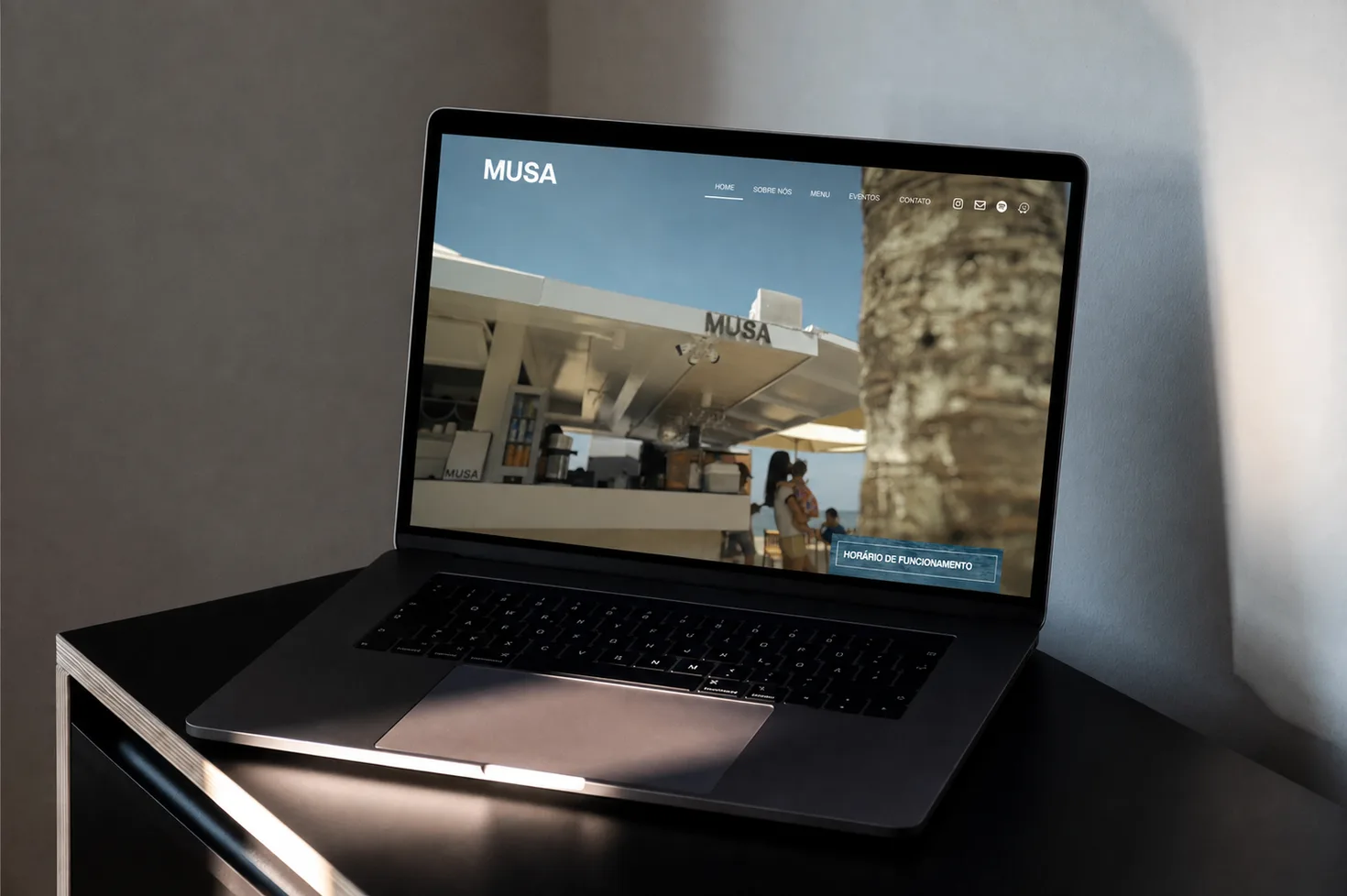
The MUSA Rio website brings together the four locations, each with an address and a map, the full menu, opening hours, the owners’ story, the events area and the contact doors, including suppliers and people who want to work there. Beyond the site, L’Atelier 54 still looks after the hosting. That is pages, content and a routine after launch, and each of those parts was in the scope from the start.
The website of photographer Gert Rudolf has a different design. It is entirely in English, organizes several fields of work into separate doors, shows client testimonials and closes with a form that already asks what the project is, what the goals are and the best time to talk. The project was run remotely, in partnership with an agency in Bali, for a client in Austria.
Both are professional websites, and the scope of each looks nothing like the other. That is why there is no single price for “a company website”.
What is already included, so it is not a surprise
In our projects there is no basic package with items “sold separately”. What is on the list below goes into every site that leaves the studio:
- On-page SEO from the first sketch: titles, descriptions, clean URLs, sitemap and structured data
- Lean code and optimized images, so the site opens fast
- Layout designed for mobile first
- A simple panel to edit text and images
- HTTPS, backups, a cookie notice and a privacy policy aligned with Brazil’s data protection law (LGPD)
- Follow-up during the first 30 days after launch
When you compare quotes, ask for the list of what each one includes. A lower price with half of these items left out is rarely a lower price.
How to ask for a quote you can compare
Before you ask, answer five questions. They shorten the conversation and make the proposal more precise:
- What does the site need to do: present the company, take orders, sell?
- How many pages do you imagine, even if it is a guess?
- Do the text and photos already exist, or do they need help?
- Are there tools the site must talk to, such as scheduling, CRM or ads?
- Is there a date it needs to be ready?
With that, the proposal arrives with fixed scope, timeline and price, with no hourly billing and no surprises halfway through.
What if the price does not fit right now?
You can start smaller. A well-made landing page already works for someone about to run a campaign, and the full site comes later, when the business asks for it. If you are unsure whether to start smaller or go straight to the full site, tell us your case in the quote.
Want to know the price of your project? Take a look at our web design service or ask for a quote: it takes four steps and needs no meeting to start.