Websites
How to Show Up on Google Without Paying for Ads: 5 Ways
5 min read

Almost every first contact brings the same sentence: “my competitor shows up on Google and I don’t, will I have to pay for ads?” Behind it there is someone who already opened the ads dashboard, saw the cost per click and closed the tab.
Anyone searching for how to show up on Google without paying for ads wants to know if there is a path that isn’t the credit card. There is. It just swaps money for consistency, and it’s worth understanding that swap before you start.
Short answer: organic results cost nothing to appear in, but they depend on five things: a site Google can read, a filled-in Business Profile, pages written for what your client types, content published consistently and a way to measure what works. None of them pays off in a week, and anyone who promises first place in 30 days is selling something they can’t deliver.
What does “showing up for free” on Google mean?
On the results page, whatever is marked as an ad is paid. Everything else is organic: the blue links and the map box with businesses nearby. You don’t pay Google to get into that part, but you do pay in time, well-written text and organization.
That’s why ads and organic don’t compete, they work at different speeds. An ad switches on and off the same day. Organic takes a while to arrive, and then keeps bringing people without charging per click.
The 5 ways to show up on Google without ads
1. A site Google can read
With no site of your own you depend on a social media profile, and Google doesn’t look there (we covered that in website or just Instagram). With a site, the basics are a tidy house: a title and description on every page, headings in order, clean addresses, a sitemap sent in, structured data and good speed on mobile.
At the studio, research into the words your client types happens before the layout, and the site is delivered indexed and connected to Search Console and Analytics 4. It’s technical, but it’s the difference between a pretty page and a findable page.
2. The Google Business Profile (formerly Google My Business)
It’s your company’s listing on Google, free of charge, and it feeds the map box. For searches with a city or “near me”, it’s often the first place a person sees you.
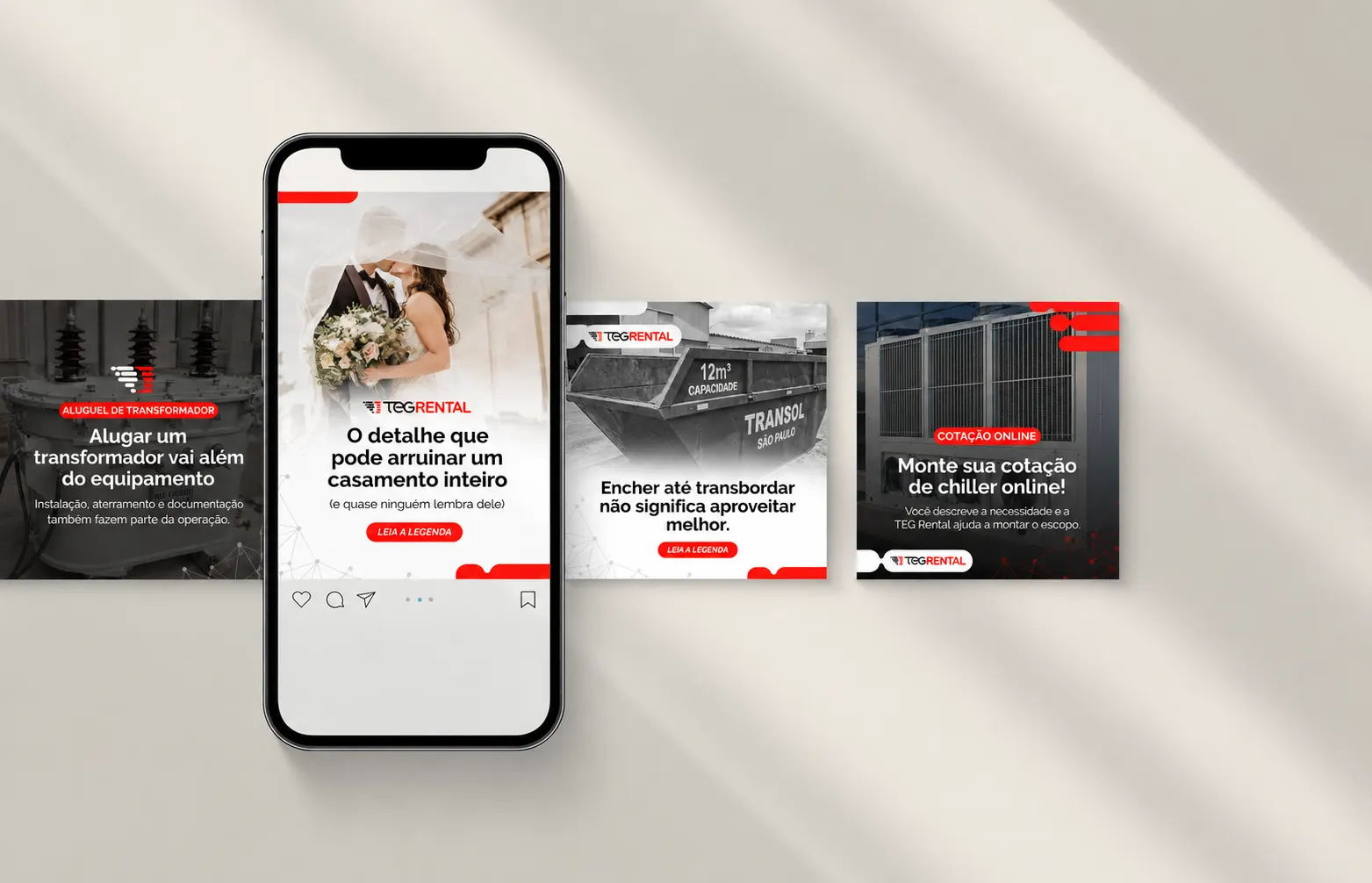
Fill in the category, service area, opening hours, phone, photos and your website address. Keep it current, with posts up to date. In the TEG Monitor and TEG Rental case study, each brand’s Google profile is part of what the studio looks after, and the case itself sums up why: it’s what shows up first for someone searching something like “generator maintenance near me” or “generator rental in São Paulo”.
3. Pages written for what your client types
Google shows pages, not companies. If nobody wrote a page about your service, it doesn’t exist for the person searching. Every important service deserves a page of its own, using the name your client uses, not the name only you use.
If you serve a city or region, it’s worth having a page that talks about it for real: sectors, neighboring towns, the questions people there ask. Swapping only the city name on a copied page is the classic mistake, and Google reads it as spam. Our approach to local pages, like the one we wrote for São José dos Campos, is built around that.
4. Content with consistency
Every article is a new way in. Someone searching a question lands on your text, gets to know your work and, if the answer is good, comes back when it’s time to hire.
The secret is answering one question per text, clearly, and publishing steadily, not in a burst of ten posts in a row. In the TEG case, the organic content of the group’s technical blog includes the CEO’s letter and articles on predictive maintenance, energy efficiency and artificial intelligence applied to industry. It’s content made for people who already know what they’re looking for.
5. Measure, so you aren’t working in the dark
Search Console is free and shows which searches your site appeared for and at what position. Without it, organic is guesswork. With it, you find out that the page you thought was secondary is the one that appears the most, and you reinforce it.
Summary: what each way asks of you
| Way | What it costs | What it delivers |
|---|---|---|
| A site Google can read | A project done once, then reviewed | The base for everything else |
| Business Profile | Setup and updates | Presence on the map and in city searches |
| One page per service | Well-written copy | Being found by the right term |
| Steady content | Publishing regularly | New ways in |
| Search Console | Looking at the numbers | Decisions instead of guesses |
When ads still make sense
Organic doesn’t replace ads, and the TEG case shows the combination. There, paid traffic brings people who are already searching for the service to the right contact, without depending only on organic. If you need results now, for a launch or a deadline, ads are the fast route. If the business is long-term, organic is what remains when the budget runs out.
Where to start in your company
If you had to pick one thing for this week, it would be the Business Profile: it’s free and takes an afternoon. After that, check that your site has one page per service and is connected to Search Console.
If you don’t have a site yet, or the one you have never showed up for anyone, see how our web design works or ask for a quote with two lines on what your business does. If your question is the content calendar, take a look at our social media work too.