Websites
Website or Just Instagram? What Your Business Actually Needs
4 min read
Juliana Ignacio
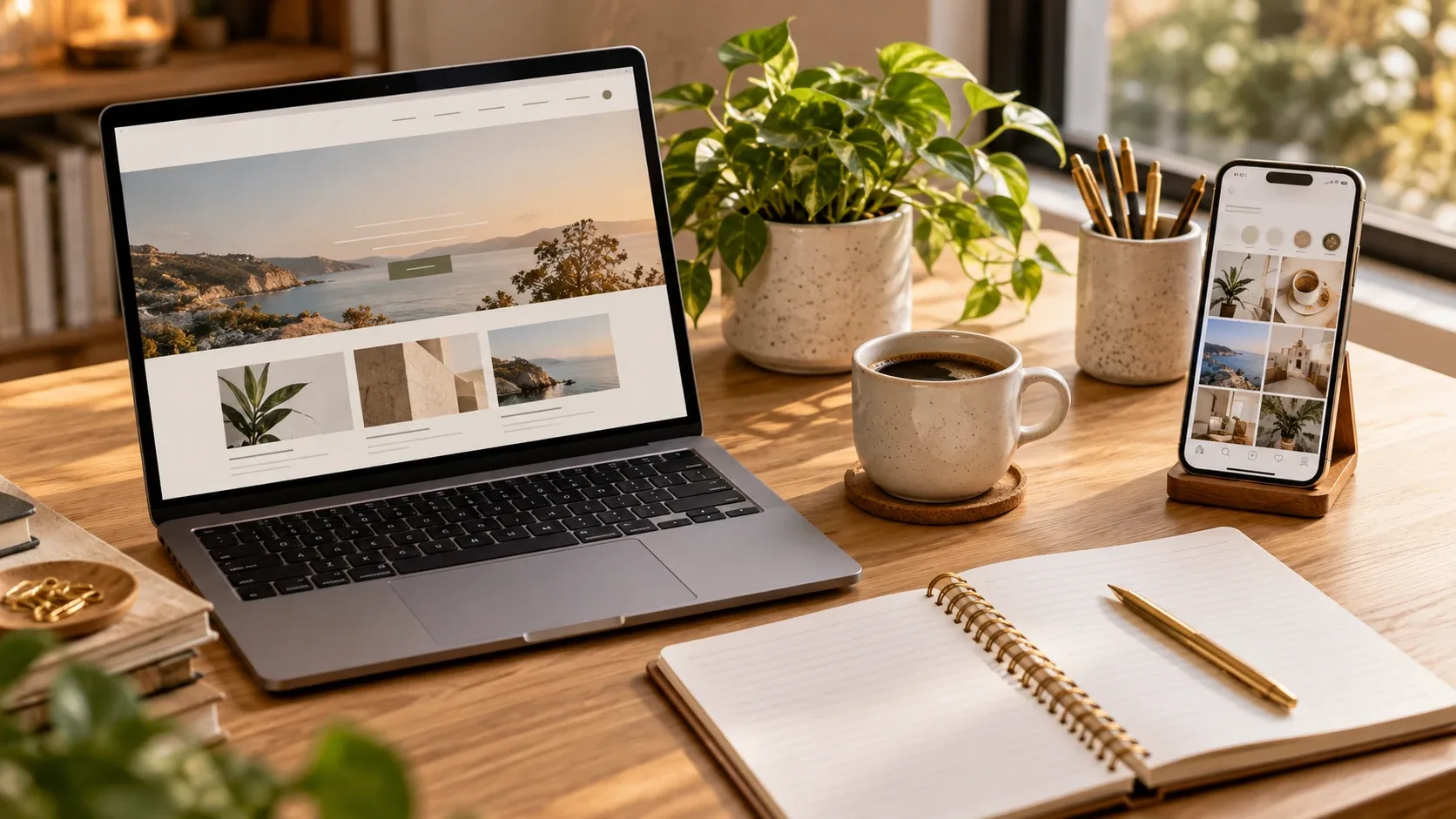
Every week someone comes in for a quote asking the same thing, in different words: “I already sell well through Instagram, do I really need a website?” It’s an honest question, and the answer is neither “yes, always” nor “no, never.” It’s “it depends on what you need to happen when someone looks for you.”
Because Instagram and a website don’t do the same job. Comparing the two as if they were competitors is exactly why so many people choose wrong — and only find out once they’ve lost time, a client, or both.
What Instagram does better than any website
It’s great at what it was built for: showing your day-to-day, building closeness, generating real-time social proof through comments and shares, and selling to people who already scroll the feed every day. Posting costs nothing, and the return can land the same hour.
The problem shows up in three places the feed never solves:
- It’s rented land. The account is yours, the algorithm isn’t. One reach change, one suspension, one engagement drop — and the history you built over years simply stops showing up for the people who already follow you, let alone for the ones who don’t yet.
- It’s not where Google looks. Whoever already follows you can find you. Whoever has never heard of you, but typed into Google exactly the service you offer, doesn’t find an Instagram profile — they find the competitor who has a website.
- It doesn’t organize complex information. A bio is two lines. Highlights have limited space. A service with a lot of moving parts, an offer with a lot of variation, or a process that needs explaining simply doesn’t fit.
What only a website solves
When the offer is too big for a feed
The Bioma case, a hair salon and spa in Piracicaba, shows this in practice. There are more than 10 rituals and 20 treatments — Velaterapia, Detox Day, Scalp Therapy, vegetable-based colouring. On an Instagram bio, that turned into a loose list nobody read to the end. On the website, each group of services got room to explain what it is and why it exists, before ever reaching the price. Instagram is still where the salon’s day-to-day lives; the website is where people decide.
When you need formal credibility, not just followers
The Gert Rudolf case, a photographer whose clients range from CEOs of machinery manufacturers to a university — many of them outside Brazil — is the clearest example. An Instagram profile shows the work, but it doesn’t carry an international negotiation on its own the way a 25-year portfolio, formal testimonials and a form that already starts the briefing do. That’s a website’s job, and Instagram doesn’t replace it.
When the business is bigger than a single product
The M7 Group case brings six different healthcare businesses under one brand — injectable medication, metabolic therapy, logistics, medical marketing. An Instagram feed shows posts in sequence; there’s no way to organize six business fronts in there. It needed a website to give each area room to explain what it does, with the group’s visual identity tying it all together.
When Instagram is already strong and you’re still missing the people who don’t know you yet
The Musa Rio case, a restaurant in São Conrado and Ipanema, had an active Instagram that turned it into a meeting spot. Even so, the website came in because it solves what the feed doesn’t: showing up for people who search “restaurant with a view” or “café near [place]” on Google, without needing to already follow the profile.
When social media is the main channel — and still leans on a website behind it
Worth pointing to the counter-example: in the TEG Group case, Instagram, LinkedIn and X really are the main content front for both brands. But even there, a technical blog exists for the group, built to show up on Google for searches like “predictive maintenance” or “energy efficiency” — because social media alone doesn’t do that organic search work. Social media done well and a website aren’t competing with each other; one is the day-to-day point of contact, the other is where organic search lands.
When Instagram alone is still enough
Without pushing the sale: there is, in fact, a moment when a website would be money spent too early. If you’re validating an idea, if the whole business runs on referrals and DMs, if today’s budget is zero, or if you’re still figuring out what actually sells — the profile does the job, and does it for free.
The simple signal for knowing which group you’re in
One question cuts through the decision: if your Instagram account disappeared today, could someone who has never heard of you find you on Google?
If the answer is no, your entire business depends on an algorithm you don’t control. That’s not a strategy, it’s a risk. And that’s exactly the point where a website stops being optional.
If you want to talk through which path makes sense now — or, like in the TEG case, whether both make sense together — see how our web design works or get a quote telling us in two lines what your business does.