Websites
Hair Salon Website: What Makes a Client Book (and What Makes Her Leave)
6 min read

Juliana Ignacio
It is half past ten at night. A woman is on the sofa scrolling Instagram and stops at a colour transformation that came out perfect. She likes it, saves it, taps the profile. And then comes the part that decides everything: she wants to know how much it costs, whether there is a Saturday slot and where the salon is, and none of that lives on Instagram.
If the link in the bio leads to a website that answers all three, she books that same night. If it leads to a pretty page that answers none, she closes it and keeps scrolling. The salon that won was not the better hairdresser, it was simply easier to hire.
That is the job of a hair salon website. It is not a shop window, it is a booking sheet.
Instagram shows the work, the website closes the slot
The two do not compete, they work different shifts.
Instagram is what creates the desire: the before and after, the blowout in motion, the exact colour she has been picturing. But a feed is a terrible place to store information. Prices change, hours change, and nobody scrolls six months of posts looking for a service list.
The website is what makes her decide. It is where the services are sorted, where she sees what each one includes, how long it takes, where the salon is and the button that books the slot. And unlike a profile, a website shows up on Google when someone types “hair salon” plus a neighbourhood, which is exactly the search of a person ready to book.
A salon with only Instagram depends on being remembered. A salon with a website gets found.
What she needs to find in ten seconds
The first screen answers four questions, in this order:
1. What you do, spelled out
The salon name in huge letters says nothing to someone who arrived through search, and Google does not understand it either. Instead of “Studio Ana · Beauty and Wellbeing”, write what she typed: “Colour, highlights and hair treatments in Piracicaba”.
The name stays where it belongs, in the logo. The headline is for the people who do not know you yet.
2. Where you are, down to the neighbourhood
Nobody crosses town for a Saturday morning haircut. Give the neighbourhood and a real landmark: “City centre, two blocks from the square”. If there is parking, that is worth more than a paragraph about the salon’s history.
3. What it costs, at least as a range
We will come back to this one, because it is the part people argue about.
4. How to book, right now
One button, large, saying what happens when she taps it. Not “Contact us”, but “Book an appointment”.
Online booking or WhatsApp?
Both, with separate jobs.
Online booking is unbeatable for a client who already knows what she wants. She picks a cut, sees a Thursday 3pm slot, confirms, done, without waiting for anyone to reply. That is how you capture the half past ten client, the very one you would otherwise lose until the next morning.
WhatsApp is for the client with a doubt, and in beauty most of them have one. “My hair is bleached, can I get that colour?” is a question no calendar can answer. The trick is to have the button open the chat with the message already written: “Hi! I would like to book a colour appointment.” A button that drops someone into an empty screen makes her freeze, wondering what to say.
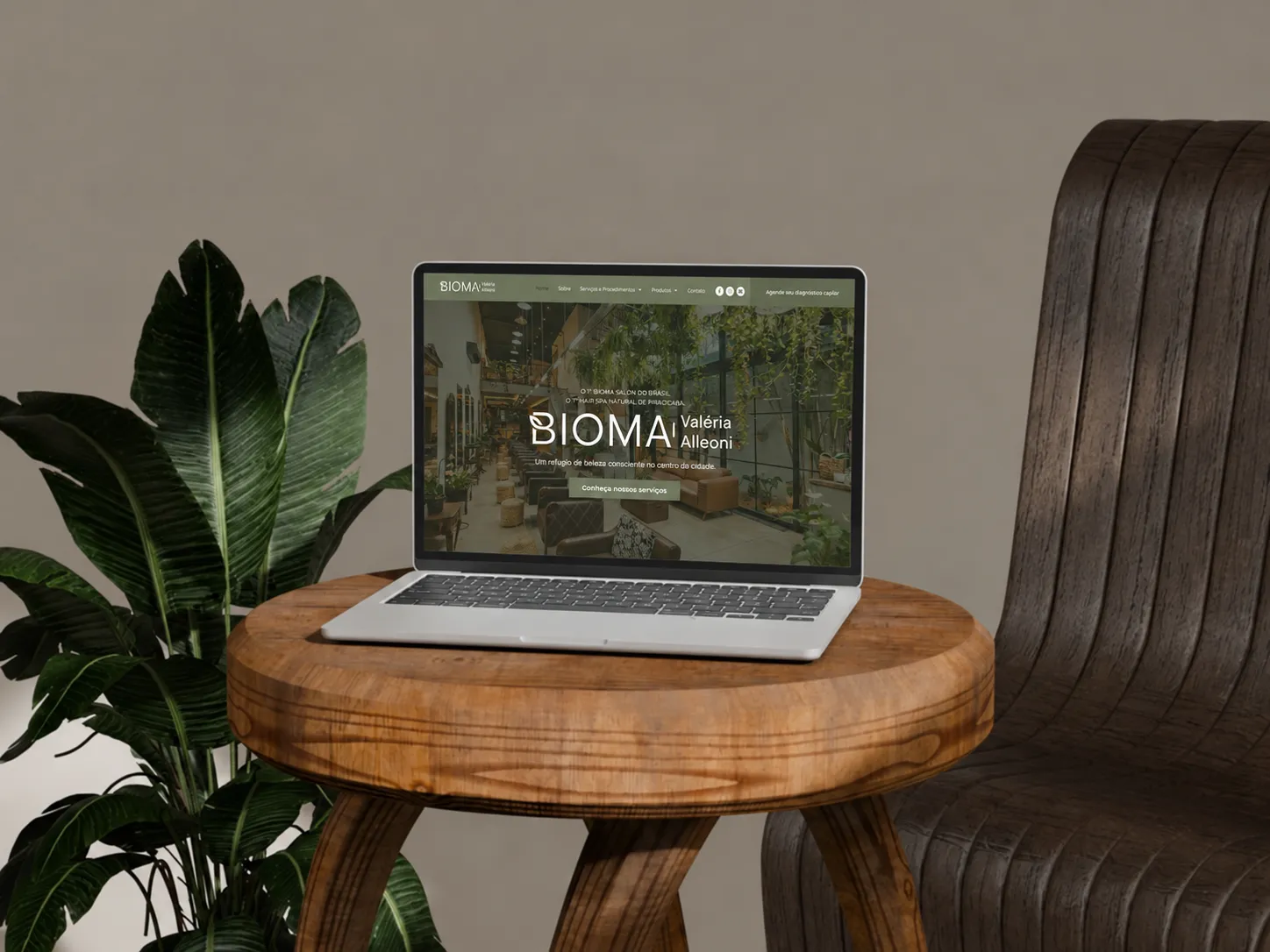
And there is a third path, the one most salons forget: someone leaving without booking should still leave her contact details. On the website we built for Bioma Salon Valéria Alleoni, the footer offers the full service menu over WhatsApp in exchange for a name and a phone number. A client who was not ready today becomes a conversation in two weeks, instead of becoming nothing.
Prices on the website: show them or hide them?
The usual objection is that prices on screen make people compare and leave for the cheapest option. The thing is, she compares anyway, and with no information she compares using the only number she found, which is your competitor’s.
The middle path beats both extremes:
- A range, not a fixed table. “Highlights from £120, the final price depends on length and base colour.” It is honest and it filters out the people who were never your client.
- Say what is included. The same price feels expensive on its own and fair when it comes with a consultation, product, treatment and blow dry.
- Offer a free way in. A complimentary hair consultation is the easiest thing to say yes to, and it is what gets her into the chair, where the real conversation happens.
A salon that does a lot needs doors, not a list
This is the mistake I see most often on a hair salon and beauty clinic website: seventy services in one long list. She scans it, cannot find what she came for and leaves. Worse, a long list pushes her to compare on price, because price is the only thing she can read quickly.
At Bioma, the answer was to open the home page into two doors, Hair Salon on one side and Hair Spa on the other. Every ritual got a name, one line about what it does and what it includes. That is what justifies the price before anyone asks for it.
If your salon also does nails, aesthetics or barbering, the same rule applies: separate the doors and let her choose her own way in.
What gets in the way and can go today
- Rotating banners with three hair photos. Nobody waits for the second slide, and it pushes the booking button off the screen.
- Heavy background video. On mobile data, that is the difference between loading in one second and in six. Six seconds is people leaving.
- Stock photography. She wants to see your work, not an American model. A real photo of the salon, even a simple one, earns far more trust.
- Music that plays on its own. At half past ten at night, with the house asleep, that is a reason to close the tab.
- A price list as a PDF. On a phone, nobody downloads it.
Half the result lives on Google, not on the website
Most people looking for a salon type something with a city or neighbourhood in it, and Google answers first with the map box and three options. Getting in there depends on your Google Business Profile: correct address, up to date hours, recent photos and, above all, client reviews.
The website and the profile work together. The profile puts you in the map box, the website is what convinces the person who clicks. Having one without the other leaves half the result on the table.
The thirty second test
Open your salon’s website on your phone, on mobile data, and count to ten. Without scrolling, can you answer:
- Which services do you offer?
- Which neighbourhood are you in?
- Roughly what does it cost?
- How do I book right now?
If any of them is missing, that is exactly where the client who never arrived is standing.
We design websites for hair salons, hair spas and beauty clinics: fast, built for the phone and with booking one tap away. See how the Bioma Valéria Alleoni website turned out, the first hair spa in Piracicaba, or get a quote in four steps, with no meeting required to start.