Websites
How to Attract Customers to a Coffee Shop From Instagram
7 min read

Saturday morning, someone scrolls Instagram and stops on a video of a cappuccino with perfect foam, on a wooden table beside a window. They save the post, send it to a friend and write “shall we go tomorrow?”. Ten minutes later the friend replies: “where is it? is it open on Sunday?”.
They go back to the profile and look. The address is in the bio, but without a street number. The opening hours were in a story that has already disappeared. The link in the bio opens a menu PDF that takes forever to load. Nobody finds what they need in under a minute, and the Sunday plan ends up at whichever coffee shop answered faster.
That is the question behind how to attract customers to a coffee shop: it is not enough to spark a craving, people have to find, in seconds, what they need to actually go.
The short answer: Instagram creates the desire, but anyone deciding to visit needs four answers on the same screen: where it is, when it opens, what is on the menu and how to reach you. When that information is scattered across stories, old captions and a PDF, part of the desire gets lost on the way. The fix is an address of your own, the link in your bio, that brings everything together on a single page.
Your coffee shop sparks a craving on Instagram. Then, can the customer find what they need to visit?
Instagram is an excellent shop window for a coffee shop, because coffee, cake and atmosphere sell through the eyes. The problem is that it was built to show, not to inform. The feed moves fast, stories disappear and a caption from six months ago ends up buried.
A customer who falls for a post almost always follows the same path: opens the profile, looks for the address, checks whether it is open, looks at the menu and only then decides. Every step where they cannot find the answer is a chance to give up and open the profile of the coffee shop next door.
What people look for before visiting a coffee shop
Before leaving home, a person wants to confirm a few things. If your coffee shop answers all of them without effort, the visit happens:
- Where it is, with the full address and a map that opens on a phone.
- When it opens, including Sundays, holidays and kitchen hours if they differ.
- What is on the menu, with current prices and photos of the items that sell by sight.
- Milk options and dietary needs, such as plant-based milk, lactose-free and gluten-free, when you offer them.
- How to reach you, with a WhatsApp button for questions, bookings or orders.
- What the place looks like, in photos of the space, so people can picture themselves sitting there.
Where those answers get lost today
Most coffee shops have all of this information. What is missing is one place where it all sits together and stays up to date. In practice, this is what the customer runs into:
| What they want to know | Where they look | What happens |
|---|---|---|
| Where it is | Instagram bio | Incomplete address, no map |
| When it opens | Stories | The story expired after 24 hours |
| Menu | Link in bio | Heavy PDF with an old price |
| Milk options | DMs and comments | Nobody answers right away |
| How to reach you | DMs | Reply only the next day |
None of these failures is the fault of whoever runs the Instagram. They are what happens when you ask a social network, built to show things, to also work as an information desk.
How it went at MUSA Rio: from Instagram to the table
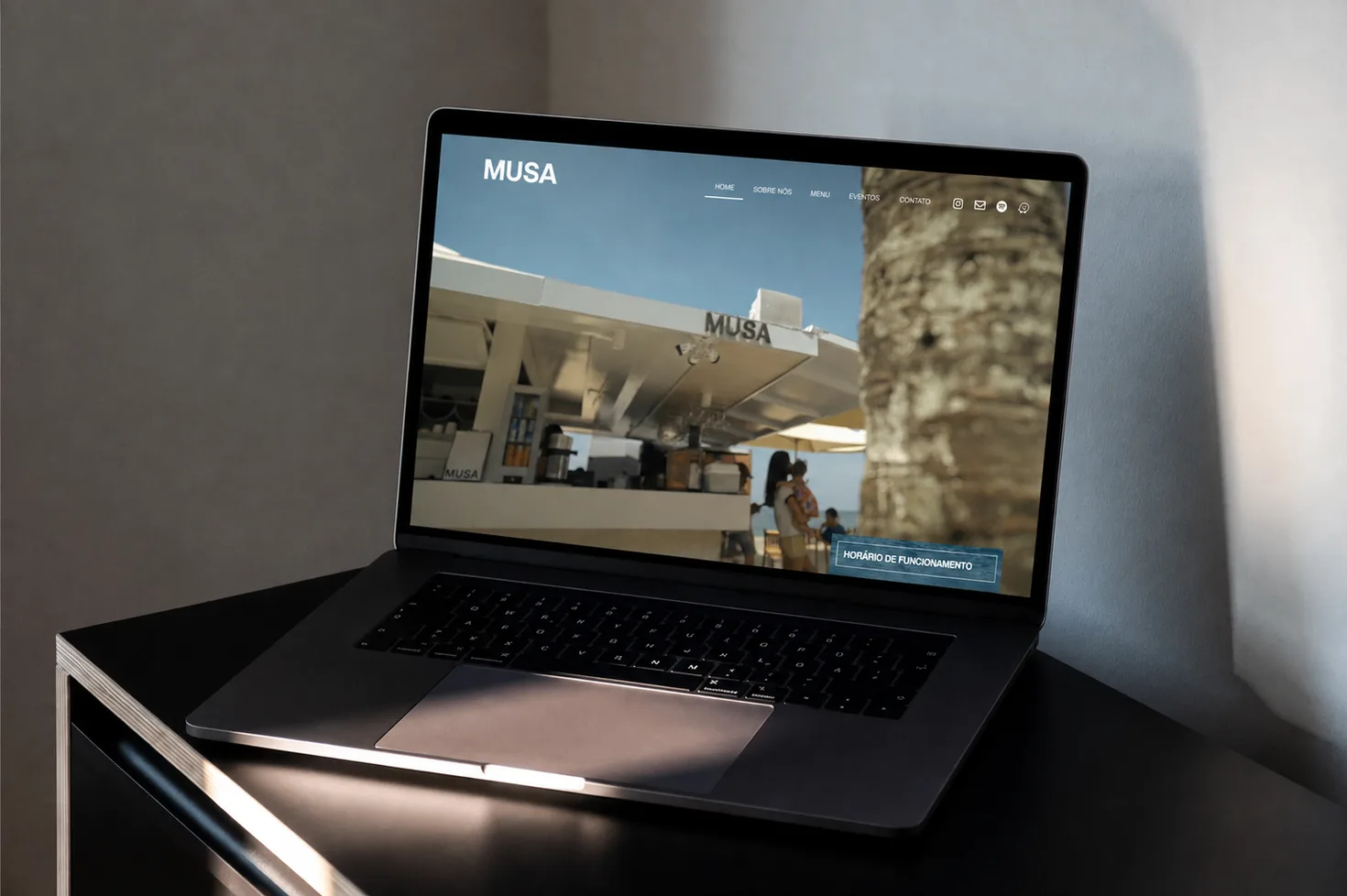
MUSA Rio is a café and restaurant with four addresses in Rio de Janeiro. When we started, its audience was already arriving from Instagram, and the house was already a meeting point. What was missing was an address of its own where everything sat together, without depending on the feed.
We built the site around the three questions people ask before leaving home: where it is, when it opens and what is on the menu. Everything on the page exists to answer one of them. The full menu lives there, next to the address, map and opening hours of each of the four houses. Since almost every visit comes from a phone, often on the street and on mobile data, the structural work was making the page open fast without cutting the images that make people want to walk in.
The practical result is a short path: Instagram sparks the craving and the link in the bio delivers, on one screen, everything the person needs to go.
What changes for a coffee shop in Rio and São Paulo
Both cities have neighborhoods with many coffee shops a few blocks apart. In that setting the choice is made in seconds, almost always with a phone in hand, which has three practical consequences:
- The first tap decides. Someone who opens the bio link and finds a slow page or an unreadable PDF does not come back to try again.
- Anyone with more than one location needs a page per house. Each address with its own hours and map spares the customer from arriving at the wrong place or after closing.
- Passers-by and regulars ask for different things. The visitor wants to see what is on offer and where it is. The regular wants to know if a new drink came out, and an up-to-date menu answers that.
Online menu for a coffee shop: PDF, QR code or a page on your website?
The menu weighs the most in this decision, so it is worth choosing the format carefully:
| Platform | Your website | ||
|---|---|---|---|
| Fast on a phone | Slow with photos | Usually | Yes |
| Updating a price | Redo the file | From a dashboard | From the page |
| Address and hours together | No | Depends | Yes |
| Your name on Google | Barely | The platform shows up | Yes |
| Stays with you if you switch supplier | Yes | No | Yes |
A PDF works at the start, but it is heavy, goes out of date and is a dead end: it does not take the customer to the map, the opening hours or WhatsApp. A QR code on the table is great for people who have already walked in, but it is only as good as the page it points to. And menu platforms are a good stopgap, with one thing to watch: if your menu lives on another company’s domain, that company gets the visit when someone searches for your coffee shop. We have written about this in who should own your website domain.
Where to start
You do not have to redo everything at once. A simple order:
- Open your profile as if you were a new customer and try to find the address, hours and menu within a minute. Note whatever takes too long.
- Check your Google Business Profile: address, hours (holidays included) and menu, which is where many people first see your coffee shop.
- Choose one single address to bring everything together, preferably on your own domain, and stop pasting the PDF everywhere.
- Point the bio link, the QR code on the table and the WhatsApp button to that same address.
Step three is worth the most. When the information lives in one place, changing the holiday hours or the price of a coffee becomes one edit instead of a marathon of posts and files.
Want your coffee shop’s Instagram to bring people to the door?
If your coffee shop already sparks a craving on Instagram and lacks an address of its own to bring together the menu, locations and opening hours, see the studio’s web design work and how the MUSA Rio website turned out. To talk about your project, the quote takes four steps and needs no meeting to start.